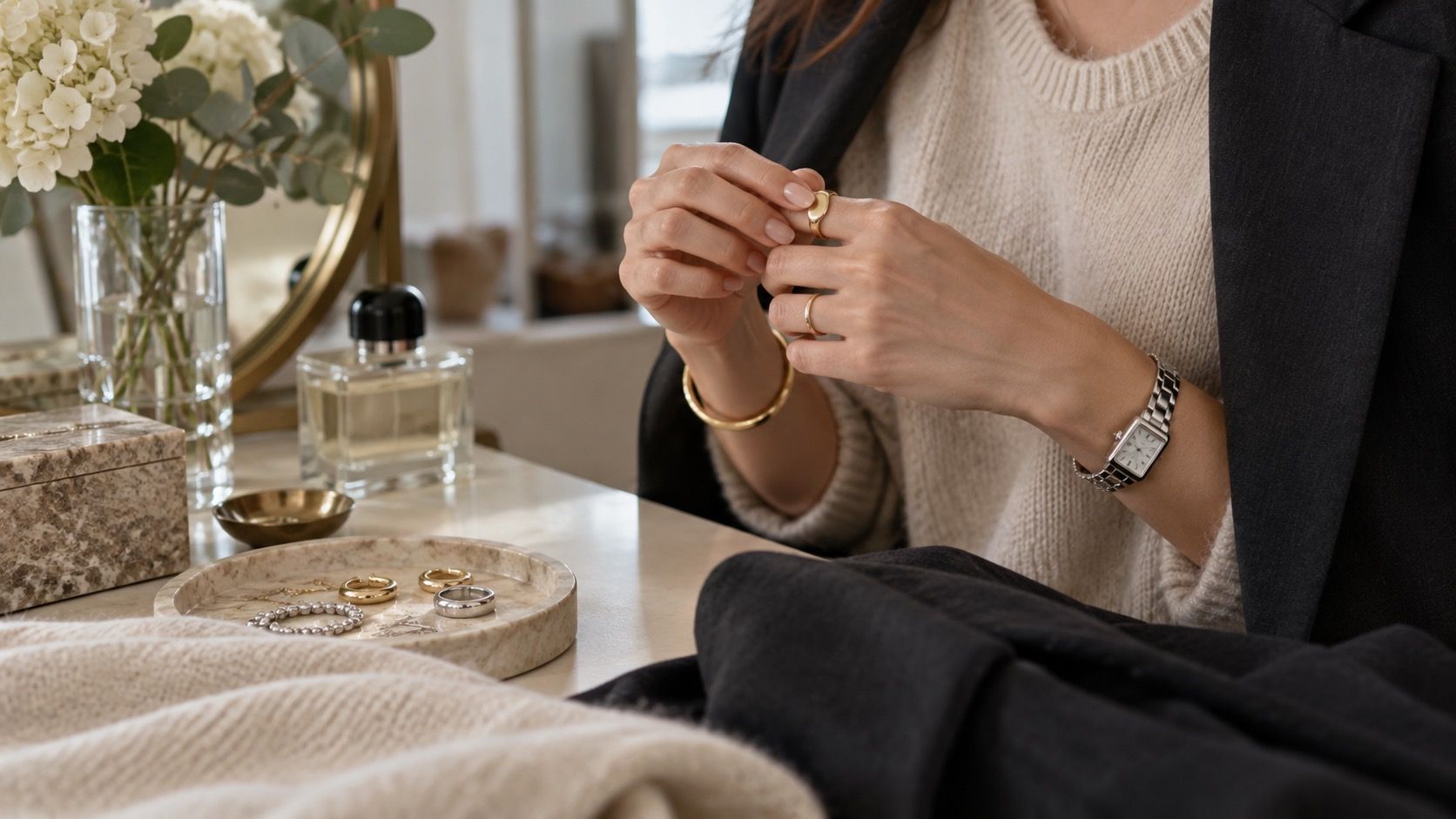
The familiar gold or silver test is useful only if it gets you out of the trap of buying jewelry that looks good in a velvet box and oddly separate once it meets your coat, knitwear, and daylight. Metals react to skin, hair, fabric, and the hardware already in an outfit. A small comparison done calmly can tell you more than a rigid verdict about undertones.
Why the usual test is only a starting point
Many gold or silver skin tone test instructions promise a quick answer from wrist veins or a single blouse. In real life, those clues are unreliable: bathroom lighting is warm, veins are not a paint chart, and a favorite jacket may change the whole picture. Treat the test as a series of comparisons. You are looking for the metal that makes your face and outfit look settled, not for a permanent label.
Compare metals beside your face in daylight
Keep the size and shape similar. Compare two small hoops, two chains of similar width, or two simple rings. A chunky gold cuff and a fine silver chain are different statements before color enters the conversation. Photograph both versions by a window and look again after a few minutes. The first option that seemed exciting is not always the one that looks most natural.
For a useful silver or gold jewelry test, stand near a north-facing window or outside in open shade. Hold gold and silver near the jawline, one at a time, while wearing a plain gray, white, or dark top. Notice whether the metal emphasizes redness, shadows, or a yellow cast, and whether it makes the eyes look clearer. Do not judge from two inches away; take a step back, since that is how other people see the overall effect.
Try the same test with your usual makeup and without it if you wear makeup often. A warm bronzer can make gold look obvious; a cool pink lip can make silver look sharper. Neither result is wrong. It simply tells you which pieces are easiest for different versions of your everyday face. Jewelry should support the life you actually lead, not a bare-faced laboratory condition.
| Situation | Try first | What to compare |
|---|---|---|
| Cool gray, navy, black outfit | Silver or white metal | Does gold add warmth you like, or look detached? |
| Cream, olive, rust outfit | Yellow gold or brass-toned hardware | Check whether silver gives a useful clean contrast. |
| Patterned outfit | Small neutral metal pieces | Let the print lead before choosing a statement finish. |
| Unsure every day | One fine gold and one fine silver chain | See which one repeatedly disappears into the outfit. |
Match jewelry to the outfit's color temperature
Outfit palette often matters more than the abstract idea of undertone. Silver jewelry can give a beautiful deliberate edge to a warm camel sweater when it repeats a cool buckle or gray boot. Gold jewelry can make a navy dress feel softer when the bag hardware and shoe buckle already lean warm. The point is to establish a relationship, not to match every metal perfectly.
Look at the neckline before choosing a necklace. A high-neck knit may need earrings or a ring rather than a chain competing at the collar. An open shirt can take a fine chain that echoes a belt buckle. If your outfit has both black hardware and brown leather, choose the metal that appears closest to your face, then let the lower details remain practical. Nobody needs to replace a good bag because its zip is a different color.
Make mixed metals look intentional
Mixed metals stop looking accidental when there is repetition. Wear a silver watch with a gold ring, then add a small two-tone earring, a belt buckle, or a bag clasp that acknowledges both. Two isolated finishes on opposite sides of the body can feel random; three small echoes read as a choice. Keep scale consistent too. Delicate chains and delicate rings mix more easily than a heavy gold chain and a thin silver stud.
Neutral metals are useful for people who move between palettes. Soft gold, brushed silver, pewter, and aged brass are less reflective than mirror-bright finishes, so they argue less with an outfit. They also show fewer fingerprints in daily use, which is an unglamorous but real advantage. A gold or silver test should help you build options, not force you to choose one team forever.
Build a small everyday jewelry set
A useful set can be modest: small silver hoops, small gold hoops, one fine chain in each finish, a simple ring, and a watch or bracelet you genuinely wear. Add one slightly larger pair of earrings for days when a plain knit needs a focal point. This gives you choices without leaving a tray full of special-occasion pieces that never meet an actual outfit.
Test new jewelry with three looks before keeping it: your most-worn dark neutral, your most-worn light neutral, and a colored top. If it works only with one dress, call it occasion jewelry and enjoy it as such. If it works with all three, it has earned a place in the daily rotation. That practical standard is more useful than any claim that gold or silver is universally better for one kind of skin.
Consider finish before color when the choice still feels close. Bright polished silver catches light sharply and can feel graphic beside black, white, navy, and crisp cotton. Brushed silver, pewter, or oxidized metal is quieter with wool, denim, and textured knitwear. Yellow gold can look elegant and clean, but a softer satin or lightly hammered finish often sits more easily with casual fabrics than a mirror-bright chain. This is why one person can enjoy both metals without changing their answer to a gold or silver jewelry test: the finish, scale, and clothes are part of the evidence. Hold the jewelry next to the actual neckline and jacket, not only against bare skin.
Season and setting give the same piece different jobs. In summer, a fine silver chain may disappear beautifully against a white linen shirt and open collar. In winter, that chain can vanish under a dark turtleneck, where medium hoops or a ring visible at the hand have more effect. A gold pendant can make a cream cardigan feel finished, but it may compete with a busy floral blouse that already has warm colors and shiny buttons. Pack for a trip by choosing one small pair in each metal and one mixed-metal piece, then wear them with the shoes and bag you actually brought. That test exposes gaps in a jewelry collection faster than a tray arranged under bedroom lighting.